Country room
Mauritania
Of the fifteen films in this room only one takes place in Mauritania from beginning to end. The rest were shot in the worker hostels of Paris, a town in Mali, a slave ship, Moscow and Guangzhou. There are three directors and all three worked far from their country — this cinema's address is not the country itself but the places its people went.
If a country's cinema is not shot in that country, whose cinema is it?
There are three stops in this room. The first is Paris: the hostels where people who went to work in France in the seventies lived, and two directors moving through them with a camera. The second is history — a slave ship, a colonial column, a queen's resistance; these films take place not in Mauritania but on the larger map Mauritania is part of. The third is Sissako: his camera in Mali, in Moscow, in China, and once, only once, in Nouadhibou.
Read more
There are three directors in this room. The country's cinema was built with that number, and the number is still three.
The Chain
1973 → 2024
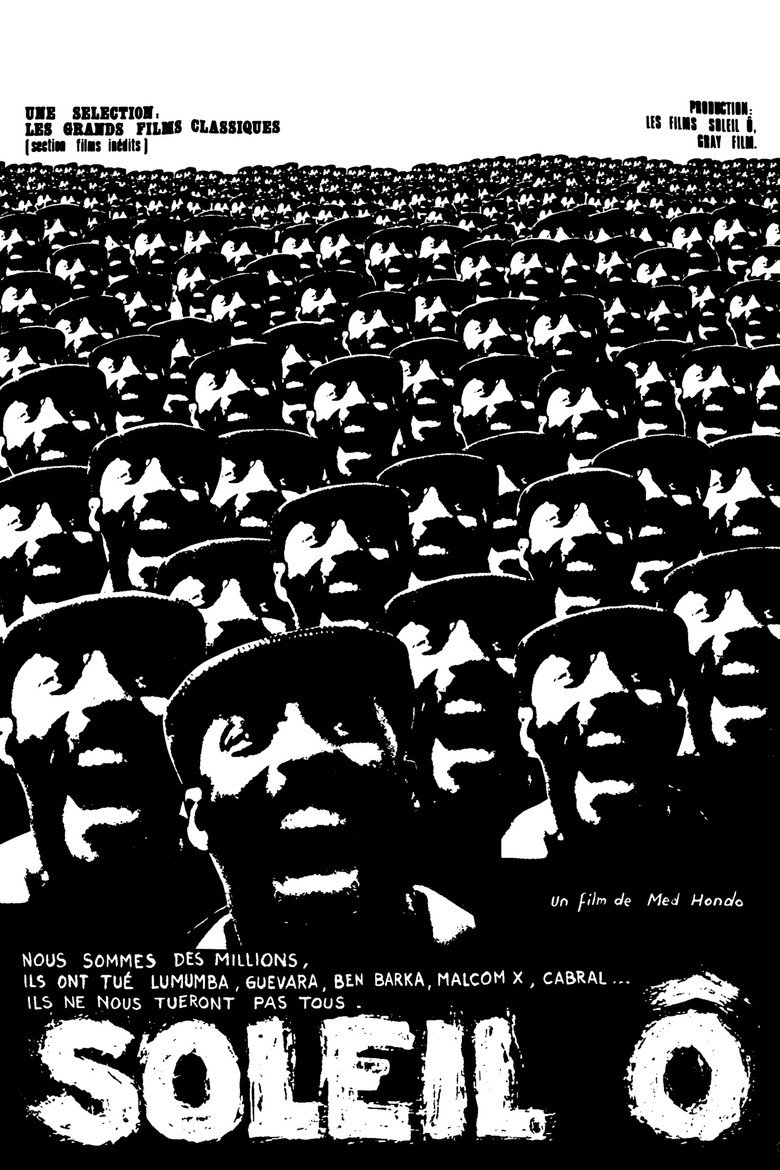
Soleil O
He arrives, looks for work, and the city turns him away at each door with a different sentence. Hondo made the film with his own money, shooting in intervals spread over years. This country's cinema begins not in a studio but in an immigrant's day in Paris. The same hostels, this time a director from inside.

Nationality: Immigrant
A workers' hostel, a shared corridor, and residents arguing about rent. Sokhona takes the camera inside the hostel and shoots alongside the people living there; those being filmed take part in the making. Two years later the same director asks who will get to speak.

Safrana or Freedom of Speech
A group of workers, the idea of returning, and a farming project. Sokhona stopped treating migration as a one-way story; the return turned out no easier than the leaving. Hondo goes looking for the history of migration and finds it on a ship.

West Indies: The Fugitive Slaves of Liberty
The set is a ship, the deck a dance floor and the hold a cargo. Hondo shot the entire film on a single ship set built in a studio; centuries pass over one another on that same deck. The musical form here was not a lightening but the opposite: a way of carrying weight. From the ship to land, and to a place where history once resisted.

Sarraounia
A queen, an advancing colonial column, and a defence that refuses to surrender. Hondo took African history out of the shape Europe told it in and put it in the frame of the side defending. Eight years later Hondo turns to the present, with genre cinema.

Black Light
A man witnesses an incident and afterwards nobody accepts what he saw. Hondo takes the thriller template and puts inside it the question of whose testimony is believed. And a second name enters the room, on the last day of the century.

Life on Earth
A return from France to a small town, a telephone exchange that does not work, and a turn of century being awaited. Sissako shot in Mali and tied the film not to an event but to a day on which nothing happens. Four years later the camera enters the country itself for the first and only time.

Waiting for Happiness
A coastal town, a young man waiting to leave, and a place whose language he cannot fully manage. Sissako shot in Nouadhibou, and this is the only wholly Mauritanian film in this room. The country's cinema arrives on its own ground some thirty years after it began, in a single film. Then Mali again, and this time the occupation of a town.

Timbuktu
An armed group takes the town, the bans arrive one by one, and life tries to pass between them. Sissako kept the violence outside the frame; what stayed inside was a ban on music and children who cannot play ball. And the last film goes to the farthest point from the country.

Black Tea
A tea shop, an African quarter in Guangzhou, and a relationship built between two languages. The room's first film opened with a man looking for work in Paris; the last shows someone on another continent who is no longer looking.
Directors in this room


